

Breaking new ground in aggregate testing
Read time: 6 mins
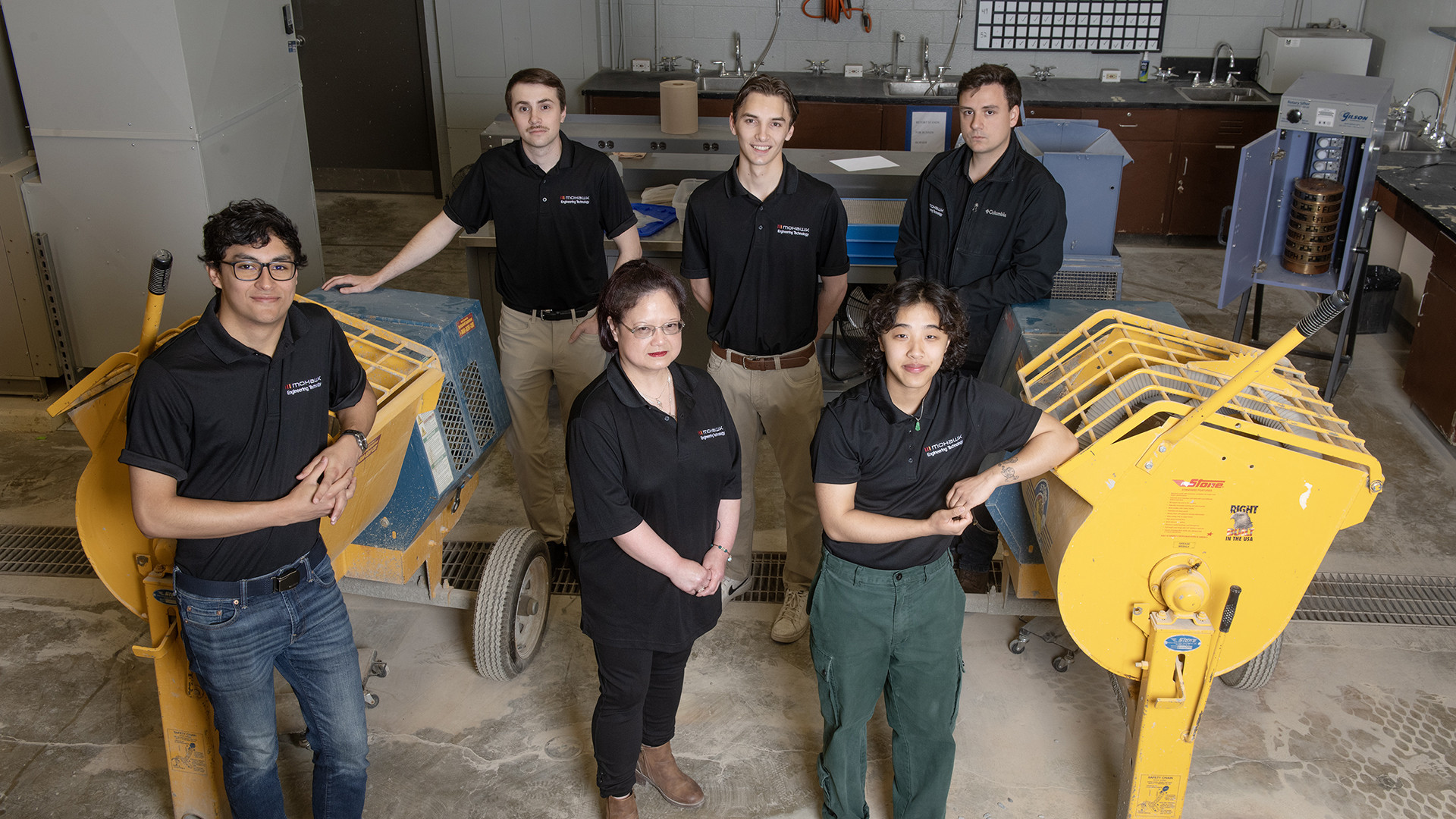
Clockwise from top left: Tyler Thiem, student; Evan Weidner, student; Tyler Sowden, Technologist; Noey Dang, student; Irene Amog, Professor, Building and Construction Technology and Engineering Technology; Oscar Padron-Janica, student.
The Construction Materials Lab is the first post-secondary institution in Canada approved by the Canadian Council of Independent Laboratories to test aggregate used in a wide range of infrastructure applications.
This past fall, Mohawk College became the first post-secondary institution in Canada to be certified for testing of aggregates used widely in the building and construction industry for asphalt and concrete designs.
The College’s Construction Materials Laboratory, located at the Fennell campus, was certified by the Canadian Council of Independent Laboratories (CCIL). CCIL, a non-profit organization representing independent, private-sector testing laboratories in Canada, offers the largest laboratory certification program in the country.
The lab is used for both applied research projects within the construction industry, as well as teaching in the Civil Engineering Technology, Civil Engineering Technician, Architectural Technology, Architectural Technician and Transportation Technology programs.
This lab is so unique, and now that we've got certification, partners not just from the region, but more broadly, will be looking to further collaborate with us. This certification not only makes us a one-of-a-kind resource for industry, but it is also game-changing for students across a number of our programs.

This certification means the college has met the standardization and interlaboratory testing requirements of the CCIL Aggregate Laboratory Certification program and is qualified to perform six tests under Aggregate Quality Control Laboratories (Type C) and five tests under Aggregate Physical Property Tests (Type D).
Irene Amog, a faculty member in the college’s School of Engineering Technology and Aviation, led the certification process along with Tyler Sowden, the technologist for the college’s Building and Construction Sciences program.
Preparation for the certification process was time-consuming and very detailed, says Sowden. It required proving the lab could complete all the tests, that its equipment worked within the specifications that are required in the industry and that all the necessary calibrations and maintenance is being performed on the equipment.
The lab also had to produce a quality manual that documents the step-by-step handling and reporting of the materials, along with a maintenance manual showing the calibrations and logs for each piece of equipment. Amog and Sowden had to prove their ability, through written and hands-on tests, to perform and teach the testing methods.
The lab will be audited every two years to maintain its certification, but all the time and effort is worth it, say Amog and Sowden.
There is a growing demand in Ontario for applied research expertise in aggregate materials testing and applied research.
The lab’s certification benefits students, who get hands-on training and the chance to be certified in industry testing – an advantage in the construction sector – but it also benefits industry partners who get the credibility of third-party testing of new materials.
Amog, who has more than 25 years of experience in testing and quality control in the construction materials industry, says Mohawk College’s primary goal in seeking certification was to provide students the opportunity to get certified.
“I come from industry and trying to get new employees certified, especially students who often only work for consultants and contractors for a short period of time, was really difficult.”
The testing work exposes students to new materials in a practical way, says Sowden.
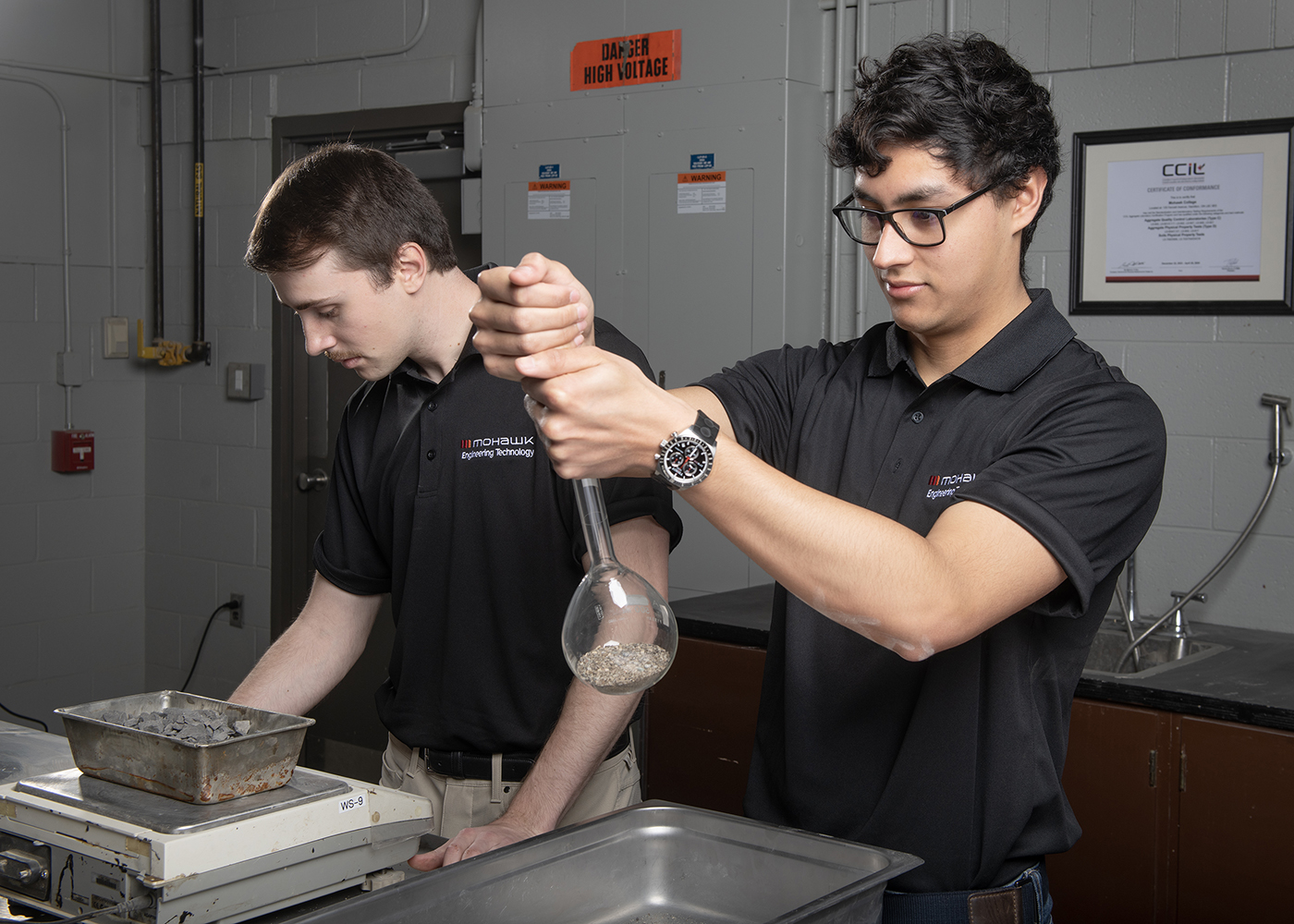
Students Tyler Thiem and Oscar Padron-Janica weigh and test the specific gravity of aggregate samples.
“Unlike other schools, we’re able to offer our students hands-on training, rather than just watching demonstrations, or scaled-down simulations. Our students get the feel of doing actual full-scale material testing procedures and have the ability to work with the equipment.”
Providing third-party testing supports applied research projects for industry partners, says McIsaac.
“Hamilton and our surrounding communities are recognized as a hub of innovation for the aggregate industry. As the first and only college in Canada to have been certified, we now can offer the industry the talent and expertise they need.”
The 3,500-square-foot lab, located at Mohawk’s Fennell campus, includes equipment to wash materials, sieve sets to grade materials into specific sizes using mechanical shakers, and ovens that can dry up to five kilograms of material at a time.
Three students in the Civil Engineering Technologist program have now achieved the certification. They have been integral to a partnership with aggregate giant Lafarge Canada to test recycled granular material for its compaction, durability and performance in road construction compared to newly extracted natural material.
“I'm amazed as to how quickly our students were able to learn the proper procedures and put a system together to test all the research samples,” Amog says of the students who achieved top marks on the certification exam.
Amog says that if testing can prove that recycled material is equal to or better than virgin aggregate in meeting industry specifications, it will cut maintenance needs, reducing costs, improving safety and providing environmental benefits.
Recycled aggregate has carried a stigma in the industry because it used to contain other construction materials such as lumber, steel slag and even other foreign material that undermined its performance.
While recycled material has been used on 400-series highways overseen by the Ministry of Transportation, many municipalities have been reluctant to adopt the materials, says Amog.
“Lafarge wants to have credible third-party testing data showing this material passes all the requirements.”
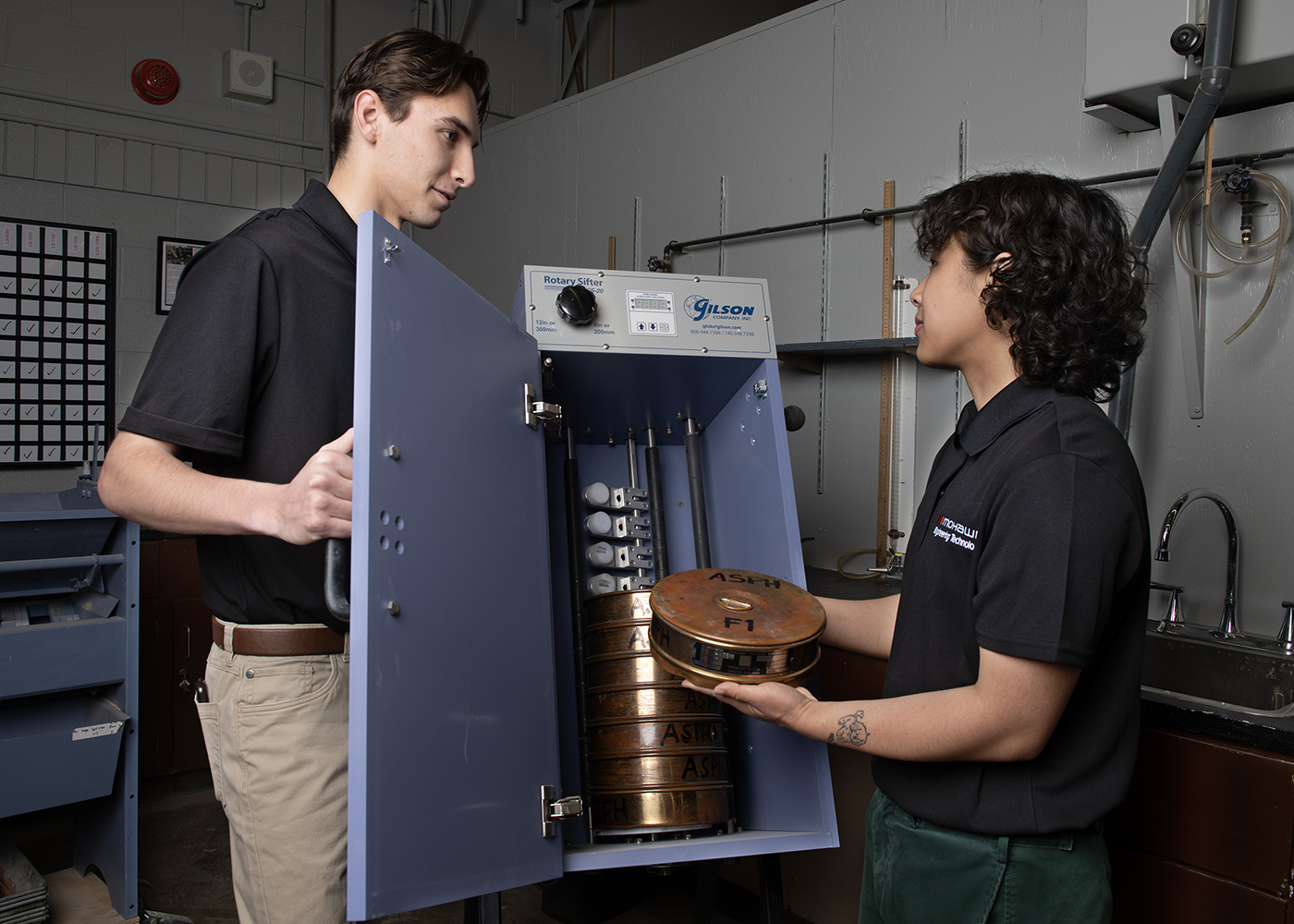
Students Evan Weidner and Noey Dang load fine aggregate into a rotary sifter to perform a sieve analysis.
Fifth-semester Civil Engineering Technology students Tyler Thiem, Oscar Padron-Janica and Evan Weidner work within the Construction Materials Lab and have all earned CCIL certification.
Each is scheduled to graduate in December after a co-op term and final school semester. They all say the testing certification will help them stand out for jobs.
“I value this lab experience because it's more working experience on top of the co-op itself,” says Thiem. “I was eager to join this research team because it's another opportunity to further my knowledge in this field.”
Weidner says working in the lab has given an opportunity to work closely with faculty and to network in the industry.
“We’ve been able to visit big industrial settings such as the Lafarge plants. Meeting with their managers has opened up new opportunities for networking, to see what's out there in the industry and just get your name out there.”
Padron-Janica says he’s interested in both the design and materials testing side of civil engineering. The certification has immediately paid off in a summer co-op at Lafarge.
“Getting the certification, plus that core experience in the lab, has given us a pretty wide angle of expertise. The certification is a huge bonus on our resumés.”
This story originally appeared in Momentum Magazine.