

Elevating Devices: On the rise
Read time: 6 mins
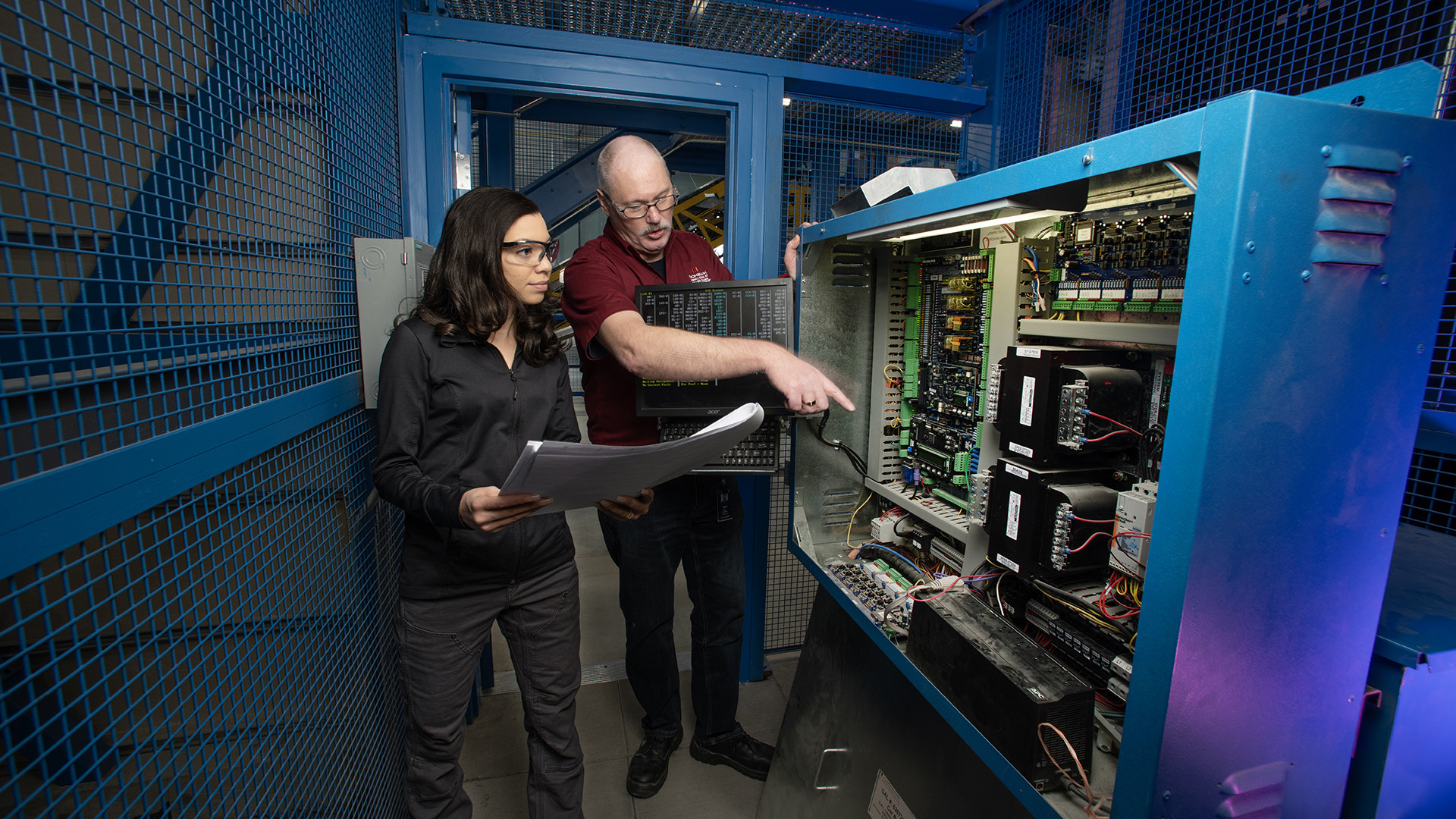
Elevating Devices Program Coordinator, Alan Bennink, and student, Melissa Brosnan work on an elevator control panel .
Mohawk College is one of just two colleges in the province offering a two-year diploma that trains future elevating devices mechanics
With the significant demand for housing, and buildings and cities only getting taller, a lot rides on developing the skills of future elevating devices mechanics to serve the vertical transportation industry.
Mohawk College’s Marshall School of Skilled Trades & Apprenticeship offers a two-year Mechanical Technician - Elevating Devices diploma program and an Elevating Devices Mechanic Apprenticeship program.
The programs cover all aspects of training, including electrical, electronics, programmable-logic-controllers, hydraulics and mechanics, that are required for installing, maintaining and servicing elevating devices.
A third cohort is now finishing the diploma program, bringing the total to about 100 students graduating from the program launched in 2020. Mohawk has also offered the in-school training for apprentices in the field since 2019.
Mohawk College, one of Ontario’s largest educators in skilled trades, is among only two colleges in the province, along with Durham College, offering a diploma in the field and one of just two non-union delivery agents in Canada approved to offer the apprenticeship.
Once upon a time, skilled trades were a plan B or C. We're thrilled to see that skilled trades are actually becoming destination careers now and we're doing everything in our power to try to create awareness of the opportunities in these fields.

It’s important to attract people from all walks of life, says Isowa.
“Mohawk College puts a great deal of effort into reaching diverse groups, including young people in high school, people from diverse backgrounds, women and girls, and second-career learners to introduce them to skilled trades careers, like Elevating Devices Mechanic, that they may never have thought of,” she says.
Alan Bennink, Program Coordinator of Elevating Devices, who teaches alongside five other faculty members, says the industry is booming, including on the residential front.
“Ground costs money, and houses, like most other buildings, are going higher and higher. As people get older, many don't want to climb stairs anymore. When you have a three- or four-storey house, at minimum, you want a dumbwaiter to carry stuff, but in a lot of cases, you probably want a full elevator to take you up and down. As a result, the demand for private residence elevators has grown substantially.”
The housing crisis, which will require more dense, multi-level housing, along with expanding transportation, healthcare and office infrastructure, will all result in more demand for skilled labour to build, install and maintain elevators and escalators.
All that construction also requires hoist devices to carry materials and workers up and down.

The College’s large Elevating Devices Mechanics Lab is equipped with three working elevators, an escalator, accessibility lifts and elevator controls. Much of the equipment has been donated by industry partners. Students in the program also have access to electrical, electronics and hydraulics labs.
Graduates are being trained to work in the maintenance and repair sector, as well as for elevator and parts manufacturers and installation companies. The program can also lead to sales or inspection jobs.
Annually, more than 100 post-secondary students and apprentices are studying through Mohawk College’s elevating devices programs.
Bennink, who came to Mohawk College about five years ago after a 23-year career in the industry, says elevators are sophisticated devices that rely on computer controls and electronics.
“I usually say most elevator mechanics do more complicated electrical work than about 50 per cent of the electricians out there. And it’s work that people rely on for their safety.”
Bennink says there are great careers, locally, nationally and internationally, to be found in the elevator industry.
“I don’t know anybody who has left the trade after becoming fully licensed. There is a high retention rate and six-figure in salaries. For me, it’s been a great career. It gave me variety, challenges to solve and the ability to work on my own and earn at a high level.”
With the program being so new, survey data about post-graduate employment is limited, but Bennink says he’s learned through conversations with students that roughly half of them secure jobs with regional companies before they even graduate.
Finlay Rae, who graduated from Mohawk’s Elevating Devices Mechanic diploma program in April 2023, now works as an apprentice with Delta Elevator, covering the territory from Brantford to Windsor.
Like many, Rae, 20, was hired before finishing his diploma. He says he knew in high school that he wanted to work in trades.
“I was better with my hands and at thinking more mechanically,” he says. One of his guidance counsellors had taught someone who became an elevator mechanic and when Rae looked into it, he was interested.
“You get to do something different every day and there is so much to learn.”
Mohawk College is helping to address a huge industry need.
Recent government employment data projected as many as 700 job openings in the elevating devices field from 2021 to 2025 — just in Ontario — with half of those being new positions.
A 2018 provincial taskforce report determined a shortage of mechanics is leading to poor maintenance and long elevator outages. Just one in five elevators in the province met all safety requirements.
As well, provincial legislation now requires that elevators return to service within 14 days, and within seven days in long-term care facilities and seniors’ residences.
“Elevators are definitely an important mode of transportation. And I think we're so used to elevators that we forget they are a mode of transportation just like a car, and they need to be maintained,” says Melissa Brosnan, a second-semester Elevating Devices Mechanic student.

Melissa Brosnan reviews schematics as she services one of the lab's elevators.
“They need to be running, and they need to be fixed on time because people depend on them. When an elevator breaks, people still need to go up and down. So it's definitely a very, very important trade.”
Brosnan is immersed in learning the basics and theory behind elevators and their maintenance and repair. It’s a fascinating career change for Brosnan, who had been working as a funeral director for a little more than 10 years.
“It’s a big change but it’s an exciting one. It's definitely challenging, but I'm learning a lot and gaining valuable experience.”
Brosnan says she was drawn to the program because of the job opportunities in the field, driven by looming mass retirements.
“There are so many places to grow, whether you're working in the field, or you're selling or inspecting, even consulting, so I thought it was a good opportunity to get an education in a field that’s seeing growth and development.”
After deciding she wanted to pursue a trade, Brosnan did research, talking to people working in different fields, including a friend working on elevators. She found out about Mohawk College’s program and applied at the last minute. She makes the trip in each day from Toronto.
“The trade is booming right now and it's a good time to get into it."
This story originally appeared in Momentum Magazine.