

Then and Now: Advertising
Read time: 7 min
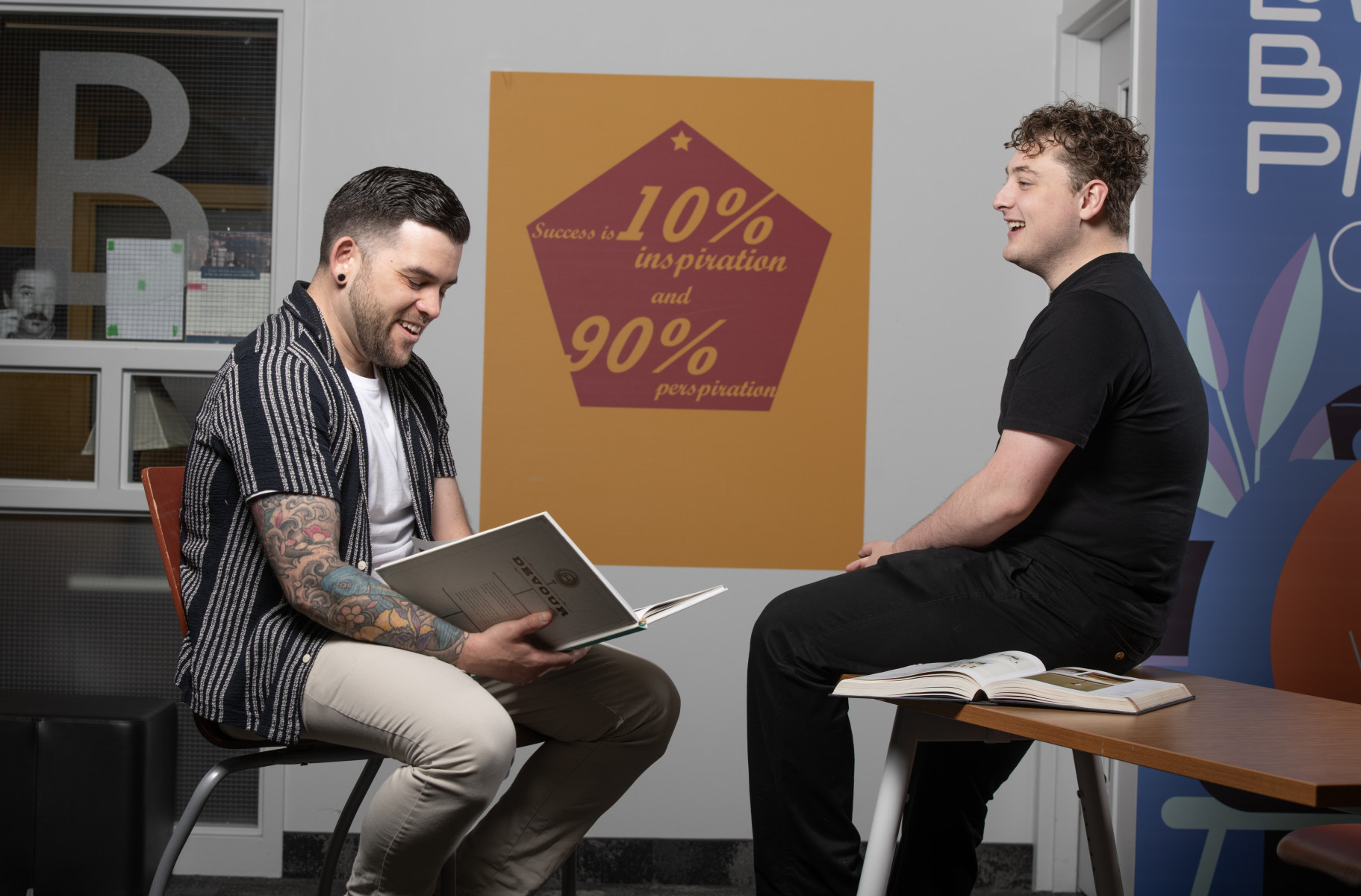
Justin Turco met up with Zacharie Cloutier in The Agency, an experiential learning program and facility operating out of room i205 at Mohawk College’s Fennell Campus
In this Q&A, 2013 Advertising graduate Justin Turco speaks with second-year student Zacharie Cloutier. Turco is Associate Creative Director at global ad agency T&Pm and has worked at a number of other agencies, including TAXI, McCann, and UNION. His clients have included some of Canada’s most recognized consumer brands. Cloutier won bronze in The One Show’s Young Ones Student Awards in New York City last year and is a finalist for two submissions once again this year.
Momentum: What made you decide to study Advertising at Mohawk College?
Justin: I feel like I've noticed that a lot of people sort of end up in the industry by accident, which is true for me and how I ended up at Mohawk. I was born and raised in Hamilton, so I've always been aware of Mohawk and lived right down the street from it. I went to Mohawk’s website, and Advertising was at the top of the list. I had a background in art and design already and I saw terms like Art Director, and I was like, I don't really know what that is but I like art, so I decided to give it a whirl. I was in my mid-20s at the time and I was just eager to go back to school and kickstart the next chapter of my life. I’m very glad I did, obviously.
Zacharie: I grew up really enjoying art, but I thought I would go to school for manufacturing robotics. Then COVID hit post-secondary schools and I took a gap year. I was watching some YouTubers and I realized that making ads is kind of interesting. My mom had a friend in the program and I hopped on a call and they explained to me what it was all about. I was like, sounds good to me, so it's just somewhat accidental for me as well.
Justin to Zacharie: Have you found any part of the program particularly challenging?
Zacharie: For me, it's setting a work life balance and dealing with self-doubt. So questioning, am I actually any good? Am I good enough? The other thing is, especially this year, I took on a lot and at times it has been hard to manage my own personal life with work. I was working really, I would say, not healthy hours, but part of that was me choosing to do that for the awards competitions. It got better recently, but it was initially just finding that balance. I’m still not great at it. I’ll think, I should take an hour break and then I’ll work another five hours straight.
Justin: It's definitely a learned experience. I’m go, go, go and I’ll bite off more than I can chew. It took me a couple years to learn how to manage that. I think a big part of being a creative in general is that self-doubt, but that's not a bad thing. That’s the kind mentality that I think pushes you, and if you can overcome that or learn how to work around that, I think it's incredibly beneficial.
Zacharie to Justin: Is there anything in the industry that frustrates you about the day-to-day of working at an agency?
Justin: It really is different everywhere. Every agency is different and the role of an Art Director could differ from agency to agency, depending on how big or small the shop is, and how much responsibility you need to take on as an Art Director. I don't know if it's a frustration, per se, but the biggest challenge I see, especially with students coming into the industry, is they forget that this is a business. We're in the creative stream and we're doing creative things, but we're also trying to sell something and our clients are paying us to do that for them. There can be a lot of ego that comes with this idea of being an “artist”, and you find people that forget the business side of the industry that we're in. But that duality is definitely part of the fun.
Zacharie to Justin: Are there any skills or talents that you find new people coming into the industry lack?
Justin: As a result of COVID I’ve spoken with a fair amount of students that aren't super keen on going into the office. Don’t get me wrong, I’m a huge fan of the hybrid work model, but I do think that, especially when you're starting out, it's important for juniors to be around people that are more senior than them. I think I learned everything about this industry by being around people that were better than me and that have been doing it for a lot longer than I have.
Justin to Zacharie: What excites you and makes you nervous about working in the industry?
Zacharie: I'll start this off with what excites me. The sense of freshness is exciting to me. Being able to work with different clients and being able to create different things and to try out different programs is a lot of fun in school. Knowing that I can continue with that and try new activations or different types of campaigns and throw different things up against the wall. As for the parts that scare me, I’m worried about getting in to the industry, and I’m hearing that there is a high turnover at some top agencies. That to me is a little nerve wracking. Then I’m also worried about how AI will evolve and how it will be used.
Justin: I've come to realize that “turnover” is something that you can't control. I try to just roll with the punches and lump that into the unpredictability of the every day and see that as a good thing. It keeps every day exciting. But, at the same time, meet and talk to everybody you can. If someone reaches out with a job opening, talk to them. Even if you might not be interested in that opportunity, you may be interested in the next one, and you'll be the first one that they turn to.
Zacharie to Justin: Artificial intelligence is here to stay. Do you see it as a supportive tool to take on mundane takes and save time or do you see it as a main source of production?
Justin: You know, I know probably as much about AI as you do. I do use it almost daily, to do quick mockups or things like that. Instead of spending three hours looking for the right Google image, I can just prompt something and get the same, or better, result in 15 or 20 minutes.
To be honest, and maybe this is wishful thinking, but I don't think it's going to take the place of me being involved in the creative process. I shouldn’t rely on a machine to come up with a vision; it's my vision that should be realized. And I think there's going to be a creative human that still needs to ideate and figure out what those AI prompts are, in order to articulate bringing my work to life the way that I envision it. For example, whether we turn to a director to bring some humanity to a project, or have AI play a role in making the process more efficient, we're relying on an outside set of “skills” to bring our vision to life on behalf of our clients. The biggest caveat, though, is the importance of learning how to use it responsibly ethically. It is, perhaps, the biggest debate that people are still having. There’ll be some trial and error, but that's part of something new coming into the picture.
Momentum: How did Mohawk prepare you for your career?
Justin: I think Mohawk, and the Advertising program in particular, does a great job of putting the emphasis on the ideation process. That's something that I think really stands out when I see people who also went to Mohawk in the industry. Mohawk grads really learn to think from the “big idea” and how that trickles down into fully integrated campaigns.
Momentum: Is there something you wish you could go back and tell young Justin at the same point in his school career that Zach is?
Justin: If I could go back and say, here's how to achieve, you know, the work life balance you're looking for, here's how to avoid yourself taking on more than you can chew and doing too much and overworking yourself, then I might if I could. But, at the same time, I think that's something that you have to learn. I don't think that's something you can go back and just say, just chill, it'll all be OK. I think you figure out how to be more efficient by doing. Sometimes you have to work through the trenches before you can see that light at the end of the tunnel.
Momentum: What is the value to students in taking part in the industry awards programs?
Justin: When I was at Mohawk, I believe my class was the first one to work on the Young Ones brief and win an award, which was incredibly exciting for us and the program. When you're a student, and all you're trying to do is put together a really awesome portfolio, it's an amazing opportunity for a really big portfolio piece. I think it’s also one of those opportunities where you're going to get to experience a real brief-to-execution process that you find in agencies. And to see Mohawk College win is so awesome. As a grad, I'm like, that's my school! As soon as you say you went to Mohawk College, there's so much credibility there because you're surrounded by award-winning work that’s come from the table right next to you.
Zacharie: The main motivation is to just put your name out there. Within my year there is a lot of competition and we try to beat each other, but it’s in a very healthy way. My big motivation for doing a lot of the awards is just to get as many pieces as possible. When I go to apply for jobs, they set me a step above and make me stand out from the crowd. After you’ve worked crazy hours, the end result is really rewarding.
Momentum: What is the greatest lesson or piece of advice you got that you carry with you?
Justin: I truly think having talent is only 50 percent of what's needed to succeed in the industry. I think being the type of person you’d want to work with yourself is the other 50 percent. You can be the most talented person in the world but if nobody wants to work with you, if you're abrasive, if you're sharp, if you're rude, you just won’t last in the industry, because nobody wants that sort of poison in their office culture.
Zacharie: I think the biggest one that helped me coming off of the heels of my first year is get comfortable with the fact that you're not going to be number one each time. You’re going to have moments where you're going to fall flat. I just tell myself I’m just going to do it and just see where it goes. If it's not great, I get to see where can I improve from and if it's good, then cool, keep building off that. I say it, but I don't always follow it, but I think that's something I try to remind myself of.
This story originally appeared in Momentum Magazine.